November 2025
It’s not that I didn’t tie flies since my last fly tying post, but I was too busy tying/fishing to write about it. Now that daylight savings time is over and it’s dark way too early again, it’s time to organize my boxes and twist up some bugs. I try to make a winter tying plan, but I usually just get out the materials I need for a particular pattern and tie a dozen or so before shifting to something else. I do have lists and try to check off needed patterns as I go, but it’s not a perfect system. I did just listen to an interesting Troutbitten podcast featuring Craig Matthews and he was talking a great deal about Pheasant Tail. My favorite PT fly is probably the Frenchie, but after listening to his words of wisdom, I need to tie more nymphs and dry flies using wild PT. Apparently it floats really well too, which I was not aware of.
I also need to tie an array of midges for this winter including more Zebra Midges. I think with all of the flashy winter flies out there a standard black zebra midge can be overlooked. To mix it up, try different bead head colors to match the wire you’re using. A small white bead with white wire shows up insanely well in low, clear water. I like a 2mm tungsten bead with small wire on a size 20. If you go super small (24-26) try a 1.5mm tungsten bead and extra small wire.
You also can’t go wrong with a size 20-22 Black Beauty. We do get some bigger midges where I live so this winter I’m going to tie a few 16’s and a bunch of 18’s as well. More is more.
For dry flies (mostly midges in the winter) I like this Stuck in the Shuck Midge Emerger. It works really, really well. If there are a ton of little midges hatching and they start mating/get clumped together try the classic Griffith’s Gnat. Matt’s Midge is another great fly to add to your arsenal as well.
Lastly, try some Buffalo Midges. They’re fun to tie and they’ll entice some aggressive eats when larger midges start coming off. Don’t afraid to skitter this pattern as well if you see some splashy rises. I’ve seen fish hunt down midges in the winter, especially on tailwaters.
Happy tying (and fishing)!
January 2025
Happy New Year and happy tying season! I realize that some of you don’t fish much or at all during the winter, which means it’s time to tie some flies. My goal every winter season is to tie enough bugs that I don’t need to spend much time at the vise once the weather warms up aside from my staples and confidence flies, which I always seem to run out of.
This winter I’ve been exploring streamer fishing. I have tied and fished streamers in the past, but I am learning why there are streamer junkies out there because “the tug is the drug.” I like a standard black woolly bugger for many situations, but I’ve been playing around with the Thin Mint as well. I met an older guy on the river once and he was going on and on about Thin Mints so I bought a few; he wasn’t wrong. Tie some up and give them a try. I changed up the color combination of the marabou, but the way Tim Flagler ties it in his video is probably still the best version of the pattern.
We have plenty of midge fishing out here in Colorado during the winter months as the mayflies won’t appear on the surface until March. I learned to fish midge dry flies in Eleven Mile Canyon and I made a video of one of my favorite patterns called the CDC Midge Emerger. Just don’t cut off the trailing shuck like I did in the video, whoops. Another incredible midge dry fly pattern is called the Stuck in the Shuck Midge. It’s one of the best midge dry fly patterns I have ever fished and once you make a few you’ll get better and better at tying them. I like a size 22, but if you have bigger midges in your rivers don’t be afraid to tie them as big as size 14! Lastly, if you see midge clusters and big fish scarfing up multiple insects at a time, don’t sleep on the Buffalo Midge. It’s a pattern I learned about years ago and I’ve caught some pretty heavy fish on this fun to tie fly.
As for nymphs, you can’t go wrong with something flashy. A very underrated fly I developed is called the Gunmetal Midge. Change up the body color to olive, brown, or even red if you so desire, but the black works just fine. Also, don’t sleep on bigger food sources during the winter. I shouldn’t tell you about this pattern, but when I talked to Tim Flagler about it he told me to make them in size 18, so even he helped me out. I’ll say no more, but here is a link for how to tie the France Fly.
I hope you all have a wonderful start to the New Year and make some of your own creations at the tying vise as well. I’m excited for a new year on the water because as my friend Darren once said, “With every cast we ask a question.” Hopefully it’s answered by a big, wild trout on the end of your line.
October 2024
It smells and feels like Fall and we’re about a month away from the end of daylight savings time, which means a great deal more fly tying is coming soon. Honestly, I didn’t have to tie too many flies since May because when the weather is nice and the fish are biting I don’t want to be behind the vise, although I do enjoy it.
As the mornings continue to get cooler the bugs continue to get smaller. I have seen some larger mayfly spinners (Slate Drakes), but other than that it’s BWO, Tricorythodes (Trico) and Midge time once again. I fished yesterday from about 10am-2pm and once the Tricos starting buzzing up and down the bite really picked up. I caught a couple fat fish on this Trico Spinner. However, I use grey wings a lot of the time instead of white and I have found that version of this pattern to be extremely effective.
As for subsurface fishing, you just cannot go wrong with the Chocolate Thunder. I love this version, but I also tie them with black or grey thread as well to change it up a bit. We have A LOT of black midges where I live so using black just makes sense and it works, really well.
Last October when the hatches started to wane I read an article about fishing soft hackle flies in the fall. Now, you can fish soft hackles all year, but the idea in the article was that the fish want to see more realistic movement when the water is low and clear. The fish want to see something that looks real (all the time), but especially in the fall. InTheRiffle made a solid video for a Soft Hackle Pheasant Tail so check it out. The thing that keeps many people from tying Soft Hackle flies is wrapping the Hungarian Partridge. My advice is to keep at it and don’t forget that less is more. One and half wraps is the max you need in order for the fly to look realistic.
As for streamer fishing in the fall, you can’t go wrong with an Olive Woolly Bugger. Many of the baitfish I’ve been seeing are not super dark, but I have seen some so don’t forget the old go to Woolly Bugger in BLACK as well.
May 2024
Spring has finally arrived here in Colorado! Frankly, the weather since February has been downright weird. April was worse than March, but May seems to be as close to normal as we get here. I spent a lot of time tying and fishing nymphs all winter, but many parts of the country have had significant hatches since March and now that May has arrived it’s time to tie and fish a vast variety of mayflies (and don’t forget those caddisflies as well)!
I visit New York each and every June and I basically need mayflies (and caddis) in sizes 8-20. I fish the Delaware River when I return to my old stomping grounds and although some of the flies are quite similar to the flies we have here in Colorado like BWO’s, hydropsyche caddis, and PMD’s (the eastern version is called a Sulphur), the hatches on the Delaware are quite different and I need every dry fly I own when I visit and sometimes I still can’t “match the hatch.”
DRY FLIES:
I like the Puff Daddy BWO for tricky trout here in Colorado and on the Delaware when I see olives on the water. I have also found the Simple Snowshoe Emerger to be quite deadly when dealing with extremely picky fish. I like this fly in sizes 14-20 as it will cover mayflies in those sizes. You don’t have to use Pheasant Tail for the body though. Change it up and use your favorite olive, brown, dark brown, rust, tan, or even yellowish dubbing (for those sulphurs or PMD’s) to make a thin body on the fly. Keep the Snowshoe though because it floats for days.
As for Caddis, you can never go wrong with the traditional Elk Hair Caddis because it’s fun to tie and it floats like a cork! For pickier fish, check out my video for a Spent Caddis. On Mother’s Day this year, I got into the famous Mother’s Day caddis hatch and this fly did the trick for some picky fish because there were SO MANY NATURALS (alive and spent) on the water. I find that the fish won’t put in a splashy effort to eat a caddis that can escape when there are easier (spent) meals to be had. Try out my spent caddis (change the body and wing color to match the naturals on your rivers) and give it a go. I have caught some really nice fish over the years on this fly.
NYMPHS:
If you’re nymphing there are so many options this time of year, but my Simple Perdigon has caught me so many fish over the past several years that I have a hard time not fishing it. Trout will even eat a size 18 in slow water so make some in that size on a strong nymph hook you trust. The thread for this fly is a non-negotiable for me as other threads just don’t seem to match the majority of the natural nymphs enough for my liking. However, I will tie a hotspot using yellow or orange thread (6/0 Danville works just fine) after I twist off the wire before covering the fly with UV Resin. Try it, you might like it.
Lastly, check out Tim Flagler’s Phast Pheasant Tail Body video. There’s a reason the Pheasant Tail is still the best producing nymph ever created. Frank Sawyer was no fool and sometimes a basic PT with no flash is the way to go for picky fish. It represents more than just mayflies so I tie and fish it in sizes 12-20 this time of year. If you’re fishing fast water though, a little flash or hotspot will get you more takes, especially if the water is slightly off color.
March 2024
Spring is a few weeks away, but that doesn’t mean the trout aren’t still eating small offerings. The weather in the mountains has varied greatly this past week so a plethora of flies have been necessary. When water temps have gotten over 40 degrees though, the fish have been eating outside of their normal winter holes. I love fishing a Frenchie this time of year in various colors. You don’t need much aside from Pheasant Tail, but experiment with different ice dub colors and see what works best in your rivers.
Another great fly for me lately has been the Bubble Back Midge. If you have never heard of this pattern give it a go, especially in deep pools during the afternoon. If you see midges in the snow or on the surface and you don’t see risers, put on a Bubble Back Midge. When the larvae inch toward the surface a little air bubble emerges and that’s when the Bubble Back can be extremely deadly.
Also, Blue Winged Olives will be hatching all over the country in the coming weeks so another fly I love to tie in brown, olive, and grey is called a WD-40. There are different origins around it, but I like how Charlie Craven ties it. This fly was developed by Mark Engler so no matter where you fish in the world, you should have some of these in your box.
I haven’t fished many Caddis nymphs just yet, but don’t be afraid to try something cream or green this time of year. Once water temps are consistently at 45 degrees and up, caddis larvae will start to move around more and with rain and snowmelt they can get caught in the drift, leading to an easy meal. I like this version tied by Tim Flagler simply called, Green Caddis Larva.
Happy hunting.
January 2024
The last week or so I have been thinking more about caddisflies because it was COLD and I need them for spring fishing. If you’ve ever read any of the late, great, Gary LaFontaine’s writings about caddis, you know they’re important. His Sparkle Emerger or Sparkle Pupa patterns are still two of the best producing flies ever designed and one of my best ever fish was caught on a Sparkle Emerger pattern.
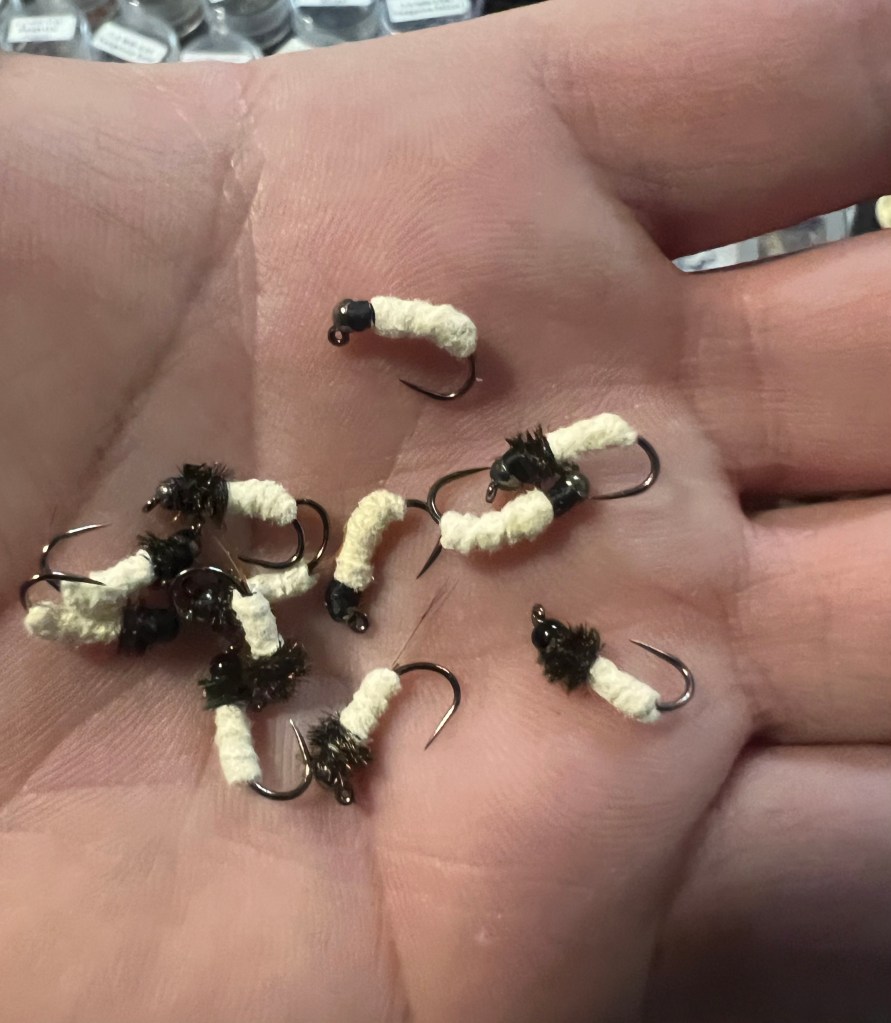
Understanding caddisflies can get a little complicated, but I’ll try and simplify them for you because I’m always learning too. There are cased caddis and free living caddis larvae that reside in our rivers. Some are large and creamy and others are small and green (or creamy). So, I fish cream/tan and green colors most of the time. This past week I have been tying different versions of the Buckskin. I learned about this pattern from Pat Dorsey and at first I didn’t have much luck with it until I did (once I started fishing it more). I will put a 2mm or 2.3mm black tungsten nickel or just a black tungsten bead on mine (sometimes) to get it down.
I also read about Bever’s Better Buckskin so I tied some up and they look quite realistic. They also look pretty sick on a jig hook with a black nickel slotted tungsten bead. Lastly, I tied some on a standard, size 16 nymph hook (TMC 3769) as well. Once you get better at cutting or slicing the Chamois cloth into the appropriate sized strips you’ll quickly be able to crank out a dozen of these in whatever variation you desire.
I like having them with or without weight and I caught some nice fish in 2023 that really chomped down on these Buckskins, which made for a good time on the river. I will tie them from size 12 down to 18.
Finally, I made a video a few years back about how I tie my version of a Peeping Caddis. I still fish this fly a lot and I will also make them on jig hooks with a black or black nickel slotted tungsten bead. I like this fly in sizes 14 and 16 mostly, but I will tie some 18’s when the water is low and clear. Like other aquatic insects, there are always caddis in various sizes throughout a river system, but they’re not always moving around depending on water temps. I have caught fish on caddis larvae from February to November so don’t be afraid to put one on as an attractor if you don’t have any better ideas! Happy tying!
December 2023
I’m still tying midges and trying to mix up different bead/wire/thread combinations to fool the winter trout here in Colorado. The cold definitely showed up after Christmas and my home river, the Eagle, has a great deal more ice than it did when I fished it on December 22nd.
Every new year I start to think about Spring (and warmer weather) so I have been tying up some big, buggy, mayfly patterns and a few caddisflies as well. My friend Tim Flagler makes the best fly tying videos on the internet and I remembered one that most people probably forgot about. It’s called the Double Standard. Click the name, check out the video and tie some up because they’ll work in almost every river on the planet come Spring.
Also, I was listening to a fly fishing podcast I love called Troutbitten and they were discussing the fact that because so many people are fishing Perdigons and “Euro Nymphing Flies”, the fish are getting pickier. Copper, gold and silver beads are the norm for Euro Flies so their logic was to fish buggier flies (like the Double Standard) in order to get more takes. I swear that as things evolve the “older flies” are going to become more and more productive.
As for Caddis, I learned about the Peacock Caddis nymph in Iceland and I’ve been making some of those using different colored thread for the hotspot. I linked Eiður Kristjánsson’s video above so check it out. I met him during my Iceland trip and he’s a great tyer and even better person!
Natural materials like Peacock Herl should be not overlooked as they have stood the test of time. Happy tying and put any questions, thoughts or ideas in the comments. It’s going to be cold the next several weeks so now is the time to get behind the vise and make it happen!
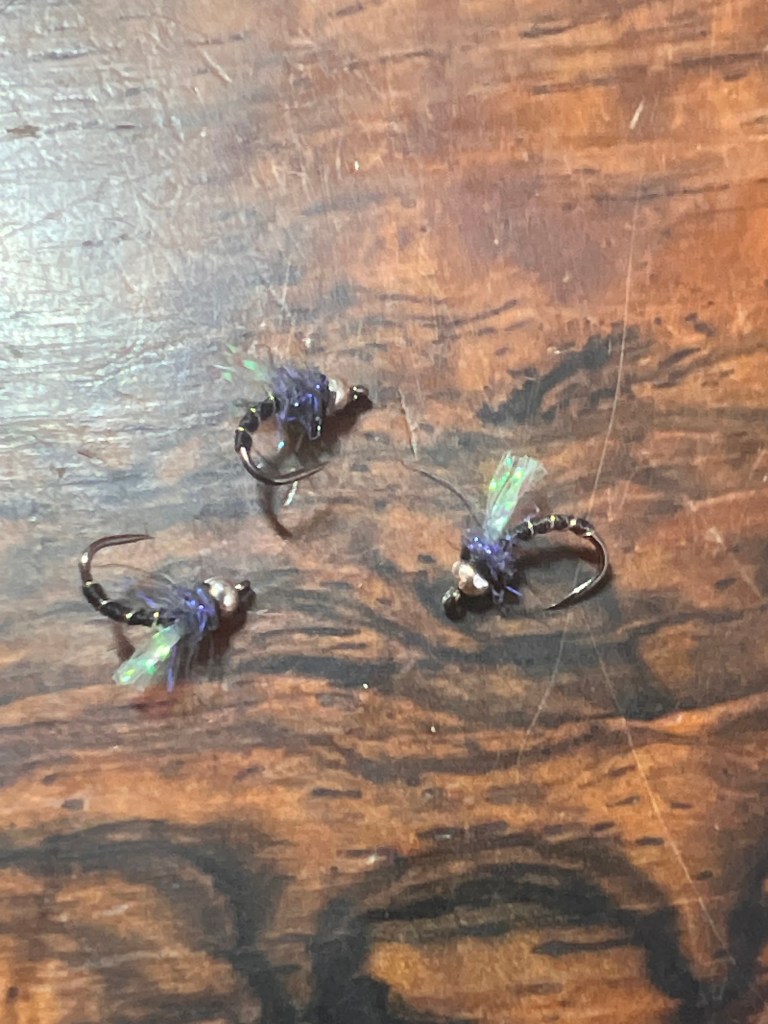
A few more midges ready for action:
 Mayfly Musings